Glencore revisted
£5.5/share basecase target; £6.8 for a fully-valued copper business

I was listening to Glencore’s FY25 Results Call in February and came across this absolute gem from CEO Gary Nagle:
“You can sit through mind-numbing presentations for hours, learning about how a highwall can be adjusted by a quarter of a degree and it’s gonna save you 4 cents a BCM.
But nobody pays that kind of attention in the rest of the industry to marketing. That’s what we do. … we can save cents on freight, cents on logistics, cents on port use, cents on storage … They do not have that in their businesses.”
I immediately sent this quote to a mate and we both burst into laughter. We’ve both been on similar calls where you’ll fornicate for hours over hypothetical parameters that simply have no impact to the realities on site. Details matter, but only if they are the right details.
If anything had endeared me to revisit my bush valuation of Glencore, it was an attitude like this!
Recent share price performance
In all seriousness, given Glencore’s recent pullback from its historic peak of £7.1/share in June, I thought it deserved another look.
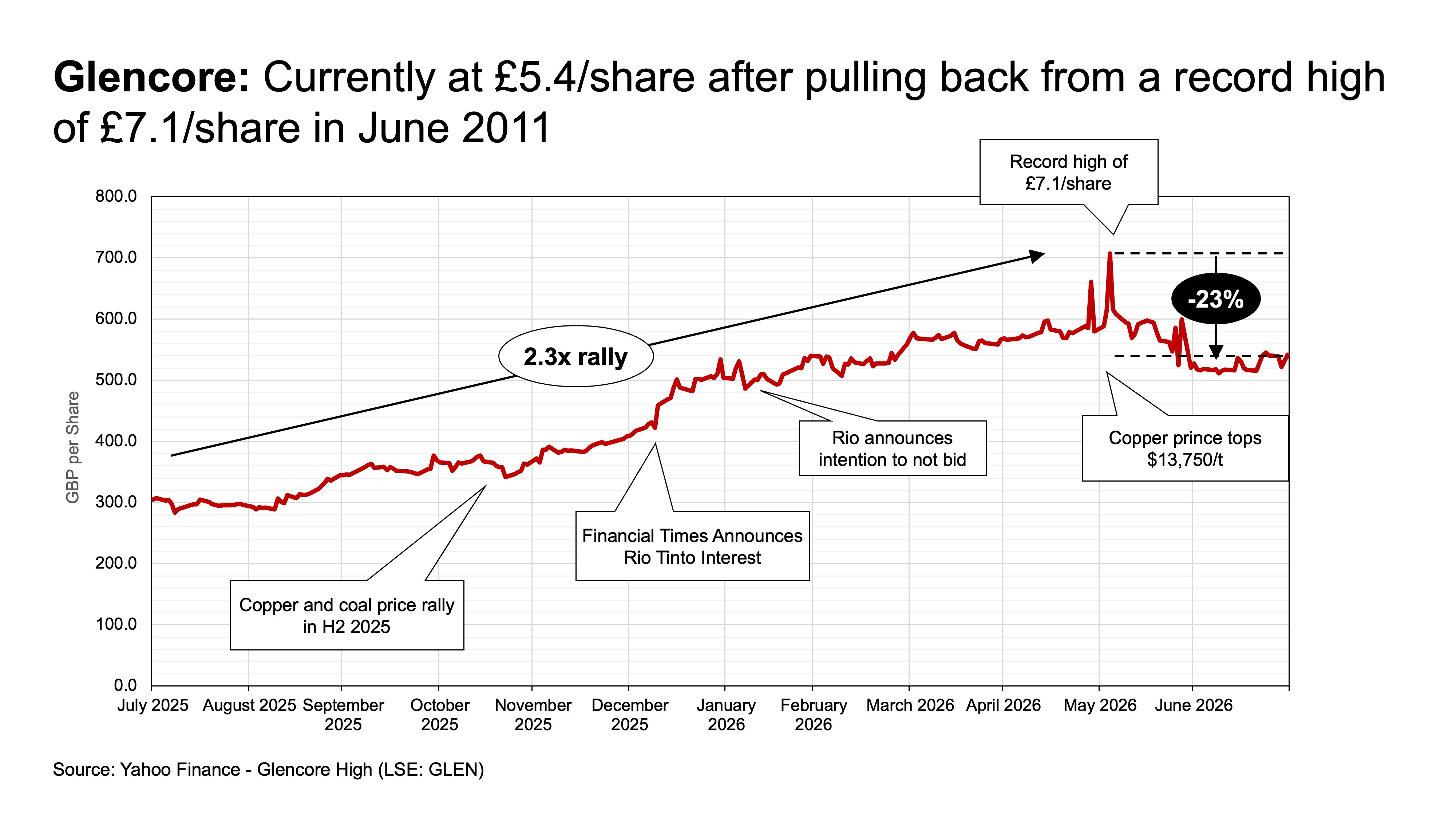
I had bought a bit in November when I wrote my initial piece on Glencore’s copper business … but sold in February when it hit £5/share as: a) I like round numbers, b) I didn’t have a basis to value their other divisions, and c), I’m a coward.
Looking back a bit before we go forward, to say Glencore’s share price has been underwhelming since its 2011 IPO would be an understatement.
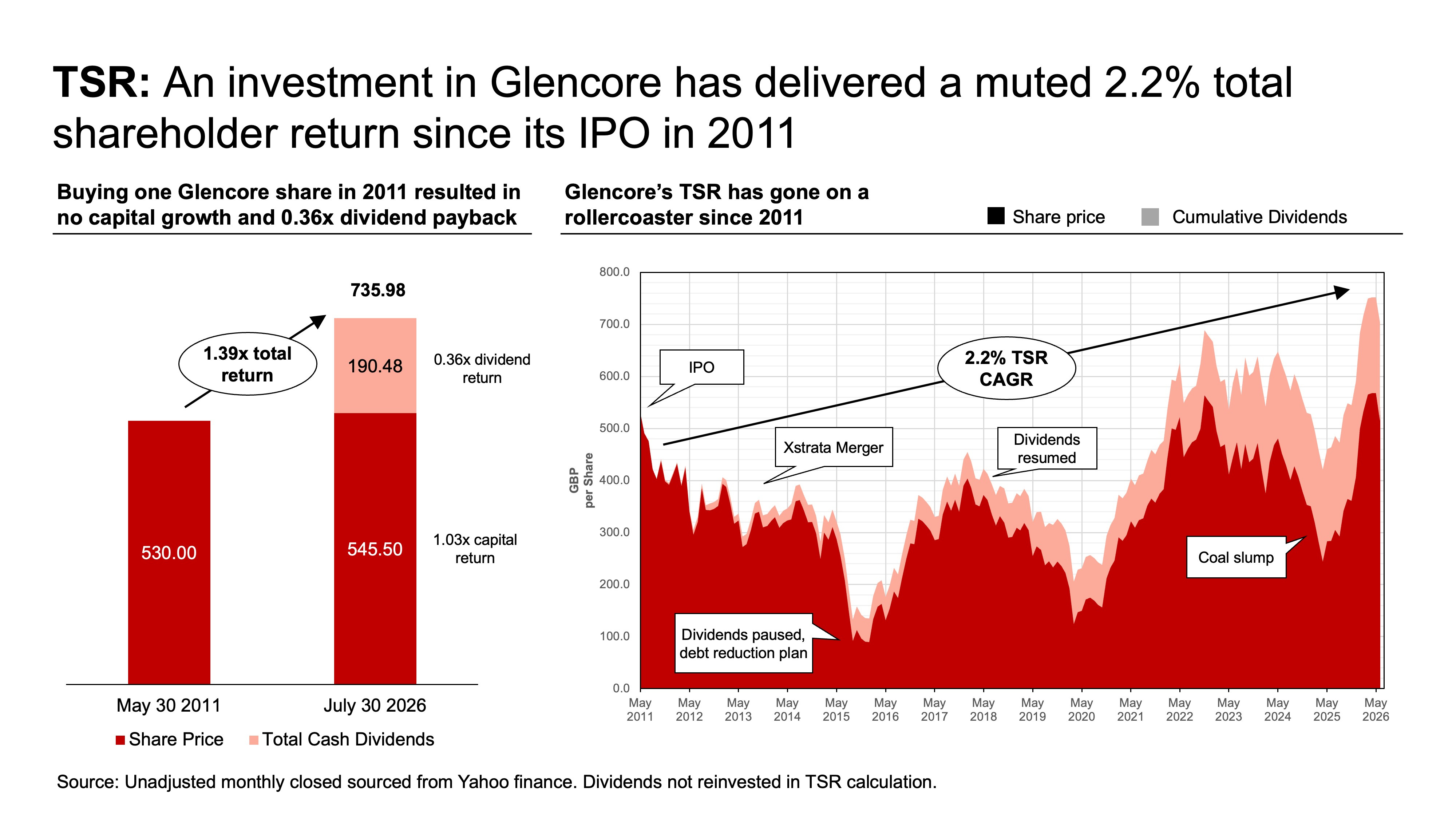
If you had held Glencore since 2011, you would have received a whopping 2.2% total shareholder return CAGR. Hook a brother up with a term deposit instead!
Glencore’s recent appreciation has chiefly been about the increase in the copper price … and copper in general was the key catalyst for Rio’s attempted merger in January.
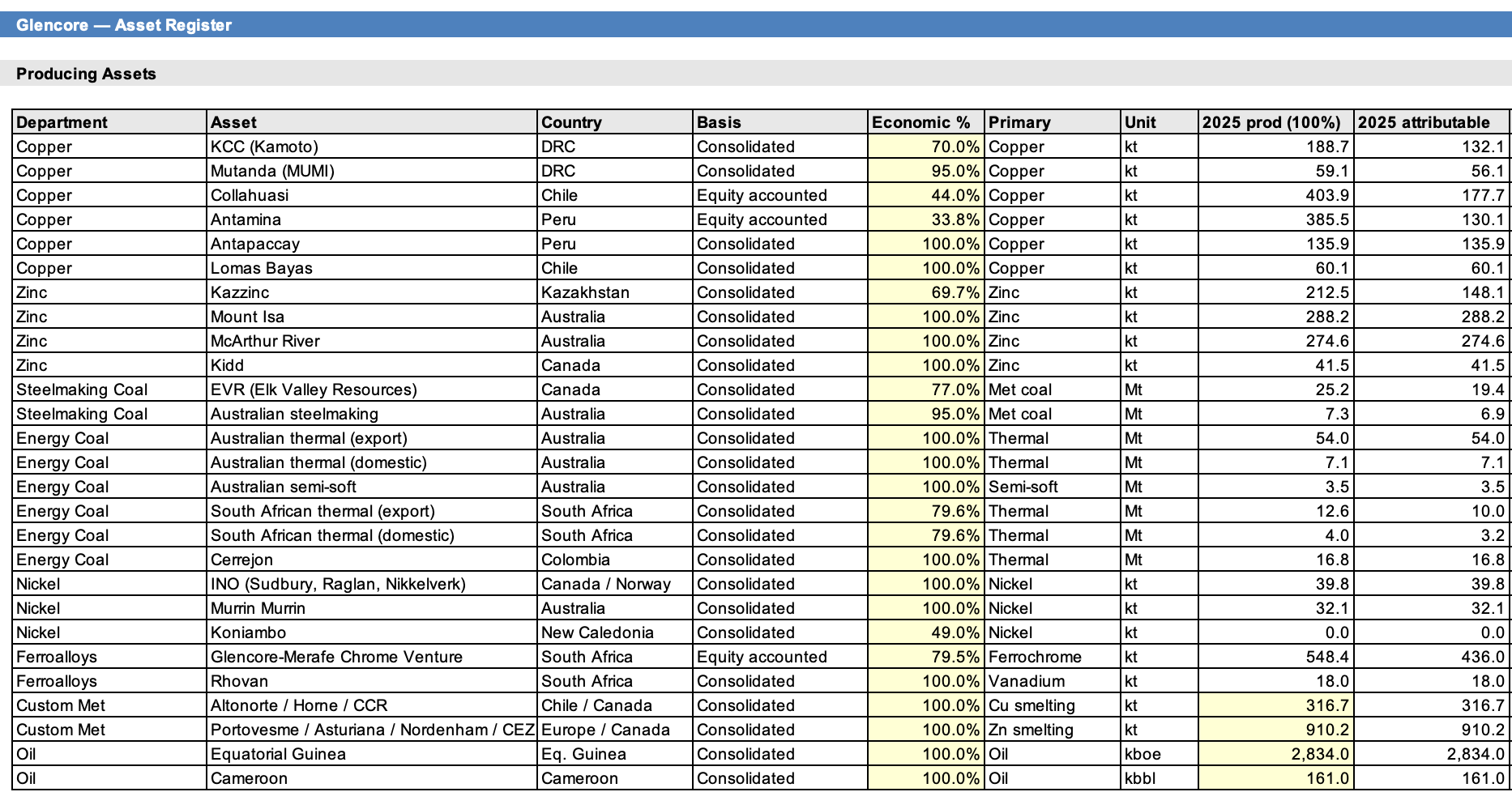
As I’ve looked at in a separate piece, Glencore is actually a heavy-weight copper producer amongst the diversifieds, with 867kt consolidated and 801kt attributable production in 2025. More production than Rio, more production than Anglo - and you often never hear about it.
It was rumoured that Glencore was holding out for a 60-40 pro-forma split in the proposed Rio Tinto bid (~£6/share+ valuation), whilst Rio was proposing 68-32 (~£5 valuation). This was against the backdrop of Glencore trading at about £4.2/share pre-announcement.
So what does our sum of the parts valuation indicate?
Valuation
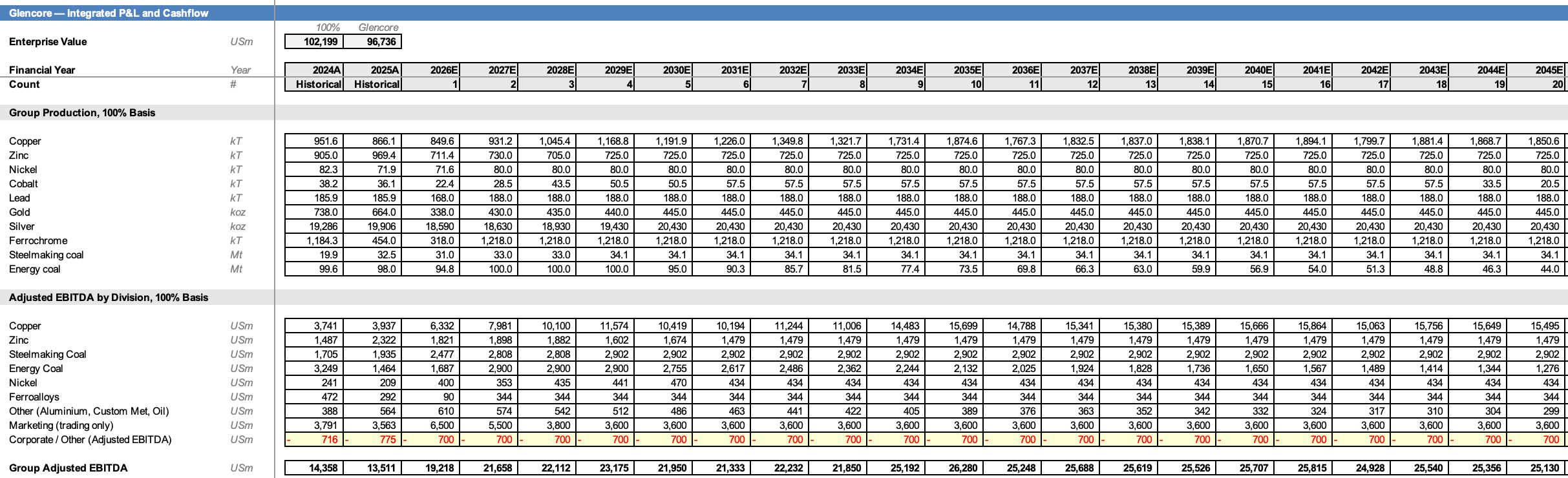
There are a lot of moving parts (and simplifications) needed to model a business like Glencore, but we’ve built a sum of the parts DCF for all 8 key businesses. The most care was taken with the Copper division and its growth projects that underpin Glencore’s investor case to get to 1,000 kt of production by mid 2028 and 1,600 kt by 2035.
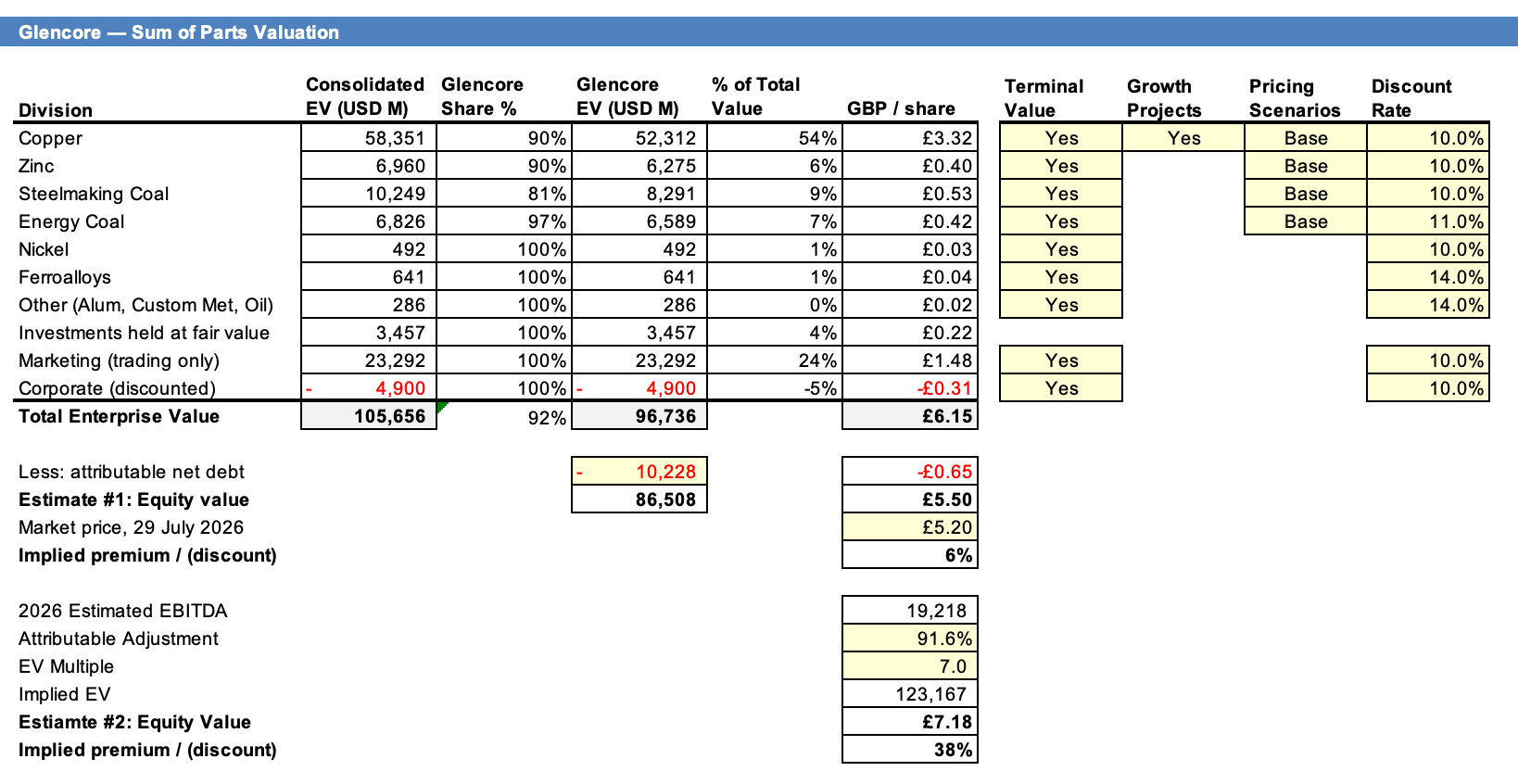
Funny enough, our basecase hits quite close to the current share price, but there is a lot of potential up (or down) side based on how you feel about the long-term outlook on Copper and Coal.
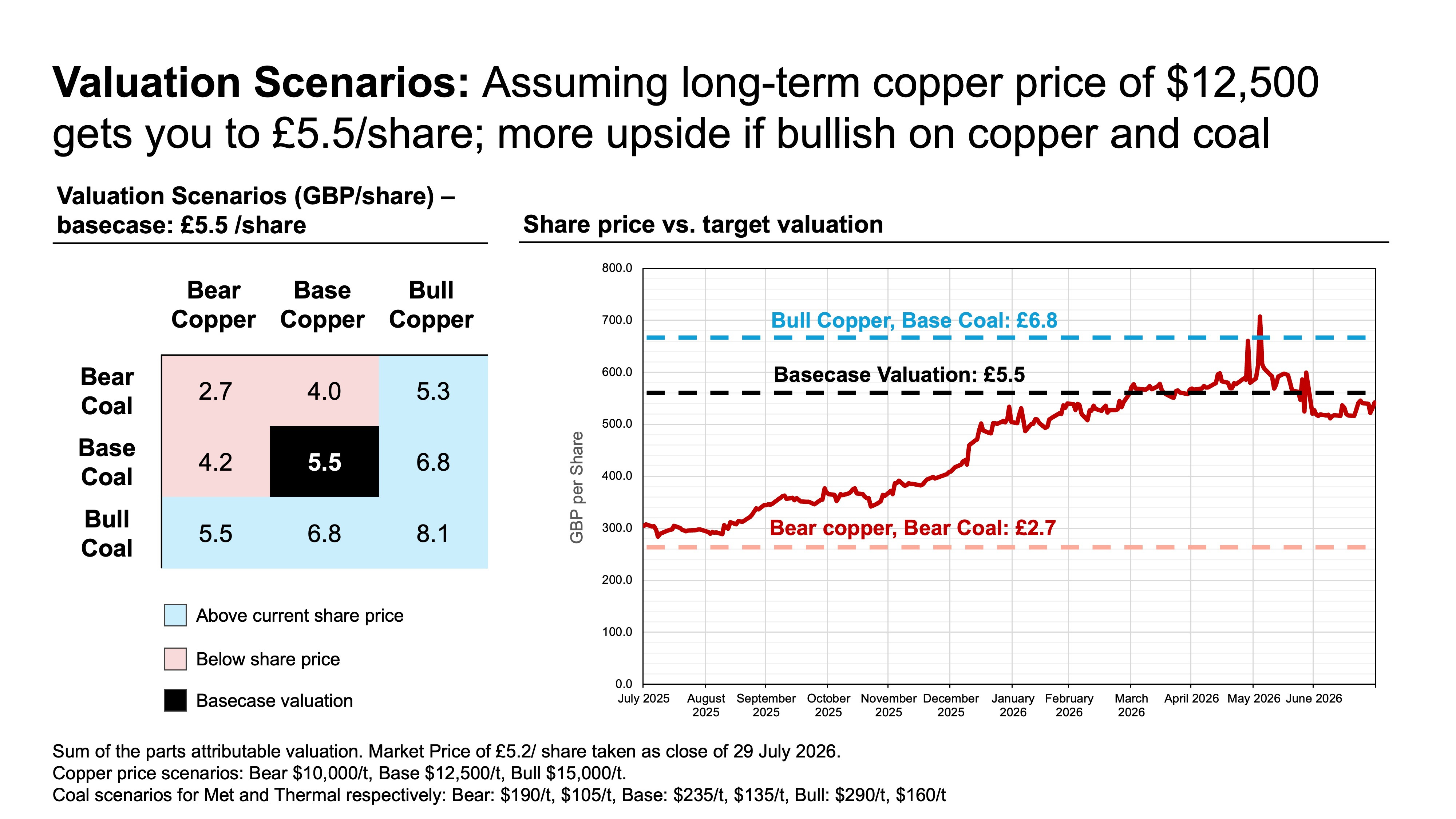
£6.8 a share if you believe in higher Copper or Coal prices standalone, £8.1/share if you believe in BOTH higher Copper and Coal prices.
A general weakness behind the model is how we’ve handled by-products contributions across the Copper and Zinc departments (and strangely in the Nickel assets too which have tonnes of base metal by-products). I had initially tried to model each stream independently, but was pulling my hair out trying to reconcile against historical and forecasted guidance. For the moment, we’ve taken Glencore’s 2026-2029 guidance for by-product credits as gospel.
On Glencore’s copper projects, colour me skeptical that they will be able to get these online independently and on-time. The following forecast has been OCR’d from their investment day materials, and will require almost $17B in capital to deliver 1,000kt of new production by 2035.
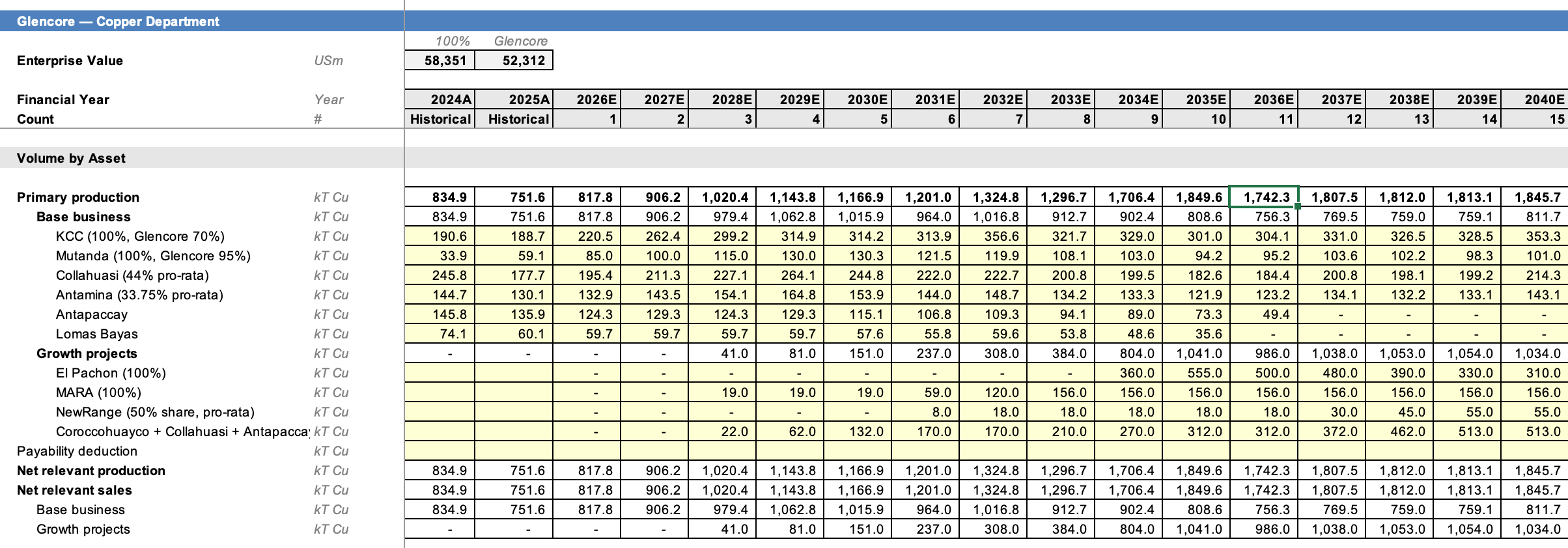
Glencore's copper production has fallen for 4 years straight, and sits roughly 40% below 2018 levels of ~1,450kt. If we switch off cashflows from its proposed copper expansion (both profits and initial capex): about £1.2 a share is shaved off our £5.5 target. Not pretty.
Glenwho?
So what is Glencore, and what is the end the game?
At face value, Glencore is a complicated business. Complicated to untangle financially and complicated to explain.
But at the end of the day, it's largely a Copper business with a trading and logistics arm that helps extract value from its marginal and niche mines and smelting assets. The trading arm also moves $220B of third-party volumes a year, and gives Glencore unique insights into physical flows, pricing, and customer demand that no pure miner has.
Its Coal and Zinc assets are solid, but Glencore’s Copper and Marketing is what makes or breaks the business and provides ~70% of value.
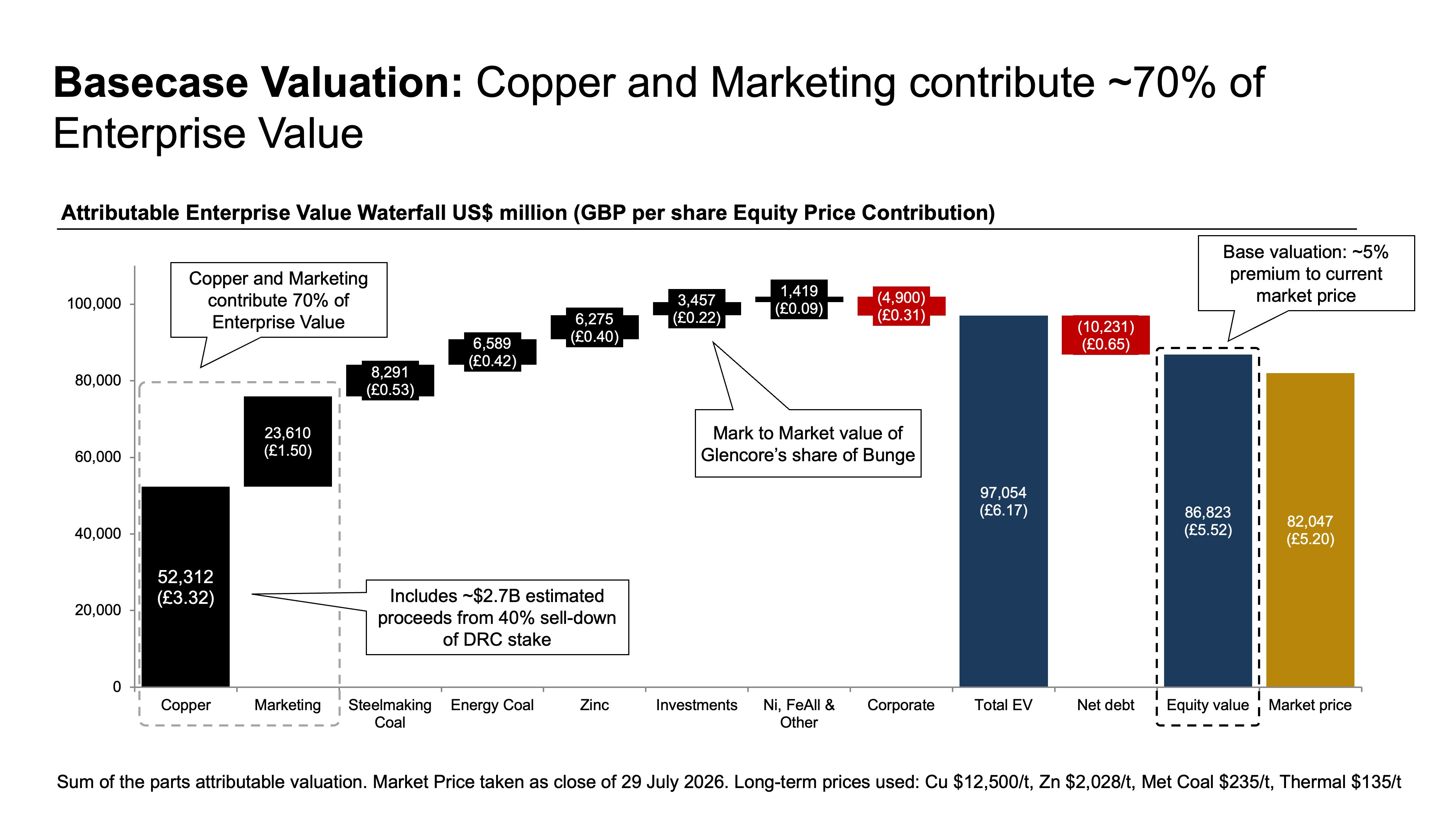
Although it is a solid standalone business, Glencore has spent years hunting a transformative deal to reward shareholders that have endured almost no capital growth since the 2011 IPO and a measly 2.2% TSR from dividends.
We had the proposed Teck deal in 2023, offering many of the proposed synergies that Anglo is touting with QB (Glencore is also part of the Collahuasi JV), plus the ability to create an even larger Zinc player by integrating Teck’s Red Dog mine.
Teck rejected the offer. Glencore settled for the Elk Valley Coal assets, whilst Anglo later swooped in to acquire a clean Copper/Zinc play ex Coal. All of Glencore’s efforts went to someone else's shareholders.
Then came Rio in January this year. Glencore purportedly came to the table willing to do a deal, but the two couldn't agree on the valuation premium (£6+/share target Glencore against Rio's ~£5). Rio's no-bid statement triggered a six-month cooling-off period under UK takeover rules that expires in August. It will be interesting to see if Rio comes back for a second bite of the apple given the pullback in Glencore's price.
The industry is consolidating around Glencore, but Glencore has yet to join the party. CEO Gary Nagle isn't shy about wanting in, complaining after the FY25 results that "all the [mining] companies are a little bit irrelevant" and that a $320B+ mega-miner would be impossible for governments and US funds to ignore. Is it only a matter of time before an acceptable exit comes for Glencore's shareholders?
The investment story for Glencore
So who is Glencore for?
If you want copper, this is a pretty solid way to get 800kt of current production and the ABILITY to more than double that by 2035. The key question is whether Glencore has the technical capability to build new mines. Most of its mining portfolio was inherited from Xstrata, and Glencore has not (to my knowledge) delivered a greenfields mine since the Xstrata era.
If you trade events, Glencore is also an interesting play. Rio's cooling-off period expires in August, meanwhile BHP has shown it is keen for even more copper exposure through its repeated pursuit of Anglo. Could they come to the table here?
And who shouldn't own it?
Anyone who doesn't want to own one of the world's largest coal books, the sovereign risk that comes with operating outside tier 1 jurisdictions, and a corporate culture and operational posture that has kept the lawyers busy.
I’m personally a bit of coal bug, so will definitely be holding a piece of Glencore - especially if things go south £5 a share. Cheers!